
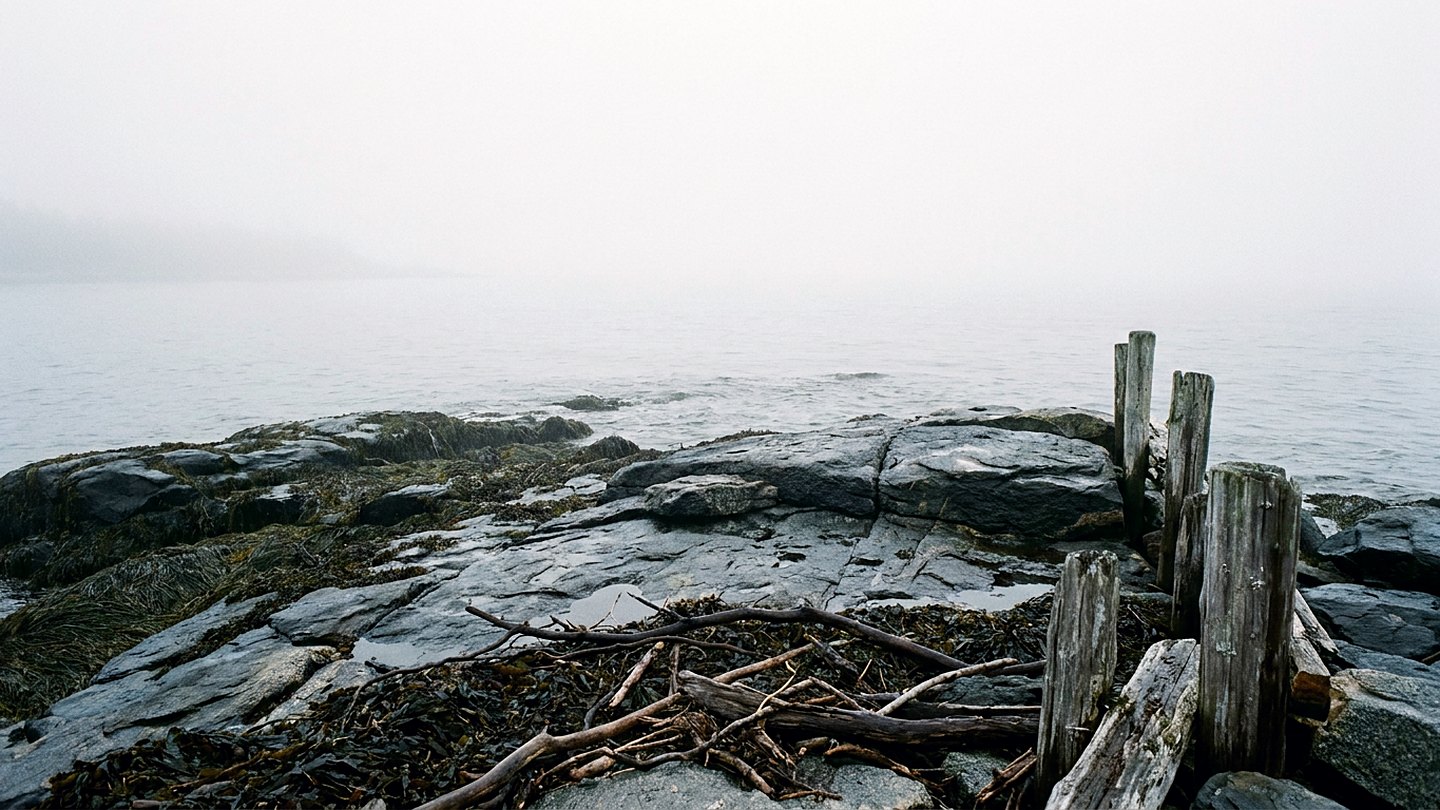
The Seacoast in Fog
Five visits to the same short stretch of coast, three of them in heavy fog. What fog does to sound and distance, and what the shore is busy with off-season.
This state gets about eighteen miles of coastline, which is not much. I have spent a suspicious amount of my time on one mile of it. Five visits in fourteen months, all to the same stretch of seawall, rocks, and a point with a light on it. Three of those visits landed in fog, which was luck rather than planning.
Fog on this coast is not weather in the usual sense. Public weather summaries describe it plainly: warm damp air moves over cold water in late spring. The moisture condenses into a low gray layer that can sit for days. Late May and June are the reliable months for it, and the rest of the year it arrives unannounced.
I did not set out to write about fog. I set out to see the same mile in different months, and the fog kept turning up and stealing the entry.
The clear visit, for comparison
The first visit was in October, on the sort of afternoon that gets photographed for calendars. Visibility ran out somewhere past the offshore islands, the water was hard blue, and the light came in flat and cold from the southwest. I could see six miles of coast in one direction and four in the other.
That clarity turned out to be a problem. With everything visible, I looked at nothing in particular for ninety minutes and came home with three notes, all of them about parking. The shore was full of people doing the same thing, which is to say pointing at the horizon and agreeing that it was there.
I remember the day as pleasant and almost featureless. It is the visit I use as a control now. It tells me what the place looks like when it is not withholding anything.
The first fog: distance stops working
The second visit came on a Saturday in late May. I drove through clear inland towns and hit a gray wall about two miles from the water. The change happened over maybe four hundred yards of road. The temperature dropped nine degrees between one traffic light and the next.
At the seawall I could see roughly two hundred feet of water and no horizon at all. The line where sea becomes sky simply was not issued that day. Waves arrived out of nothing, broke, and went back into nothing. The effect was less spooky than domestic, like a room being cleaned by someone you cannot see.
Distance judgment fails immediately in that condition. A person walking toward me stayed a vague shape for far longer than felt right. Then she resolved into a woman with a dog, in what seemed like a single step. I misjudged the same approach three more times and never improved.
The light in fog is even and shadowless, which flatters nothing and describes everything. Wet granite goes the color of a nickel. Rope, paint, and orange floats on the pilings look almost too bright, since they are the only saturated things left.
What fog does to sound
The third visit is the one that changed how I use the place. Heavier fog, a Tuesday morning in June, almost nobody around. I sat on the rocks near the point for an hour and mostly kept my eyes closed. That is a strange thing to admit about a coastal visit.
Sound in fog behaves oddly. Some of it seems to arrive from the wrong direction, and some carries much farther than it should. I heard an outboard motor for eleven minutes and never saw the boat. I also followed half a conversation about a refrigerator, from two people I never saw at all. They were off to the right somewhere, a hundred yards out at least.
Under all of it, the horn on the point ran its pattern: a low note, a gap, a low note, a longer gap. It is not a mournful sound in person. Up close it is a large machine doing a job, more like a truck than a poem, and the gulls ignore it entirely.
The waves sounded closer than they were. Twice I stood up to check the water level, and twice the water was exactly where I had left it. Without a horizon, the ear has no help from the eye, and the ear apparently overestimates.
The off-season shore
Two of my five visits fell in the shoulder months, and those showed me that the coast keeps working when the crowds go home. In November the parking area held eleven cars, nine of them belonging to people who never left the vehicle. That is a real coastal activity here and I have come to respect it.
The shore itself was busy in a low-key way. A crew was replacing planks on a stairway down to the sand, with a generator and a radio going. Their unhurried competence was the most calming thing I saw all month. Two people walked a metal detector along the high-water line in a careful grid.
Off-season is also when the town becomes legible. Half the storefronts on the main road were closed until spring. The year-round diner had a line out the door at eight in the morning. For the first time in my notes, the harbor held more working boats than pleasure boats.
The fifth visit, and the pattern
By the fifth visit I had a small theory to test. The fog changes what I do with my time, not only what I can see. It held up. On clear days I walked about two miles and stopped twice. On fog days I walked half a mile and stopped constantly, since the interesting thing was always near.
Fog makes a mile of coast much larger by removing everything beyond arm's reach. You end up looking at wrack lines and barnacle rings on the pilings. You notice old paint on a railing, cracked in a pattern like dry mud. It is the shore at reading distance.
There is a fair argument that this is poor visibility and I have talked myself into liking it. I accept that. I would still take a foggy Tuesday over a clear Saturday on that mile. Three of my last four visits were arranged accordingly.
Going back
I am going back in late May and again in June, since those are the months that reward it. October stays on the list as the control visit. What I have stopped doing is checking the forecast the night before and canceling. The fog here does not appear in forecasts with any confidence, and the drive is only an hour.
Practical notes, since fog hides more than scenery. The seawall walkway is paved and level for about half a mile, with curb cuts at both ends. That section works for most visitors, including anyone using wheels. Past the pavement it becomes rounded granite and loose cobble, which turns slippery in wet air.
The state parking areas run on seasonal hours and fill quickly on summer weekends. In the off-season there is far more space than demand. Restrooms at the coastal park are closed outside the summer season. Wear more layers than the inland temperature suggests, since a wind off the water costs ten degrees.
If you get one visit, take an early weekday morning in June and ignore the forecast. Walk the paved half mile, sit on the wall near the point, and let the horn set the timing. I will be out there in about eight weeks, hoping for weather most people would call disappointing.
What I checked
- State coastal park pages listing seasonal hours, parking areas, and shore access rules
- Public weather summaries describing sea fog along the New England coast in late spring
- Town pages for the harbor and beach areas, including off-season parking notes

Asma Tarrant, founder and editor. Filed from Manchester, New Hampshire.