
A Town Built Out of Its Own Ledge
A former granite town southwest of Manchester, visited three times: stone steps, grown-over cutting yards, and a museum open three hours a week.
The town is about fifty minutes southwest of Manchester, and I have been three times: once in October, once in April, once in June. It had granite once, in the way that a place can have an industry so completely that the industry stops being a fact and becomes the shape of the streets.
You can see this within four minutes of parking. Every set of steps up to every front door is granite, cut square, worn into a shallow dish at the center. Curbs are granite. Retaining walls are granite laid dry, no mortar, stones the size of a suitcase stacked by people who knew exactly how heavy that is.
Nobody sells this to you. There is no visitor center and no marked route, or if there is one I never found it. There is a small museum that opens three hours a week, the shortest hours I have encountered anywhere, and it took me three visits to get inside it.
First visit, October, everything closed
I arrived at eleven on a Sunday in October with a general plan and no research, which is how most of my first visits go and is not something I recommend out loud.
The village is maybe six streets. The main one runs downhill toward a brook, and the sidewalk on the north side is granite slab rather than concrete, laid in sections about six feet long, tilted now by frost into a gentle unevenness. I walked it twice, once looking at buildings and once looking down, and the second walk was the better one.
The buildings are brick and clapboard, two and three stories, with granite lintels over the windows. Several storefronts are apartments now. Two were empty with paper in the glass. There is a diner, a hardware store, a post office, and a church with a stone foundation that makes the wooden building above it look temporary by comparison.
The museum door had a card in the window listing hours: Saturdays, ten to one, June through September. It was October. It was a Sunday. I had achieved a perfect score.
Second visit, April, mud and a locked gate
I came back in April, on a Saturday, which was progress. It was also April, so the museum was still two months short of opening, and I had not learned as much as I thought.
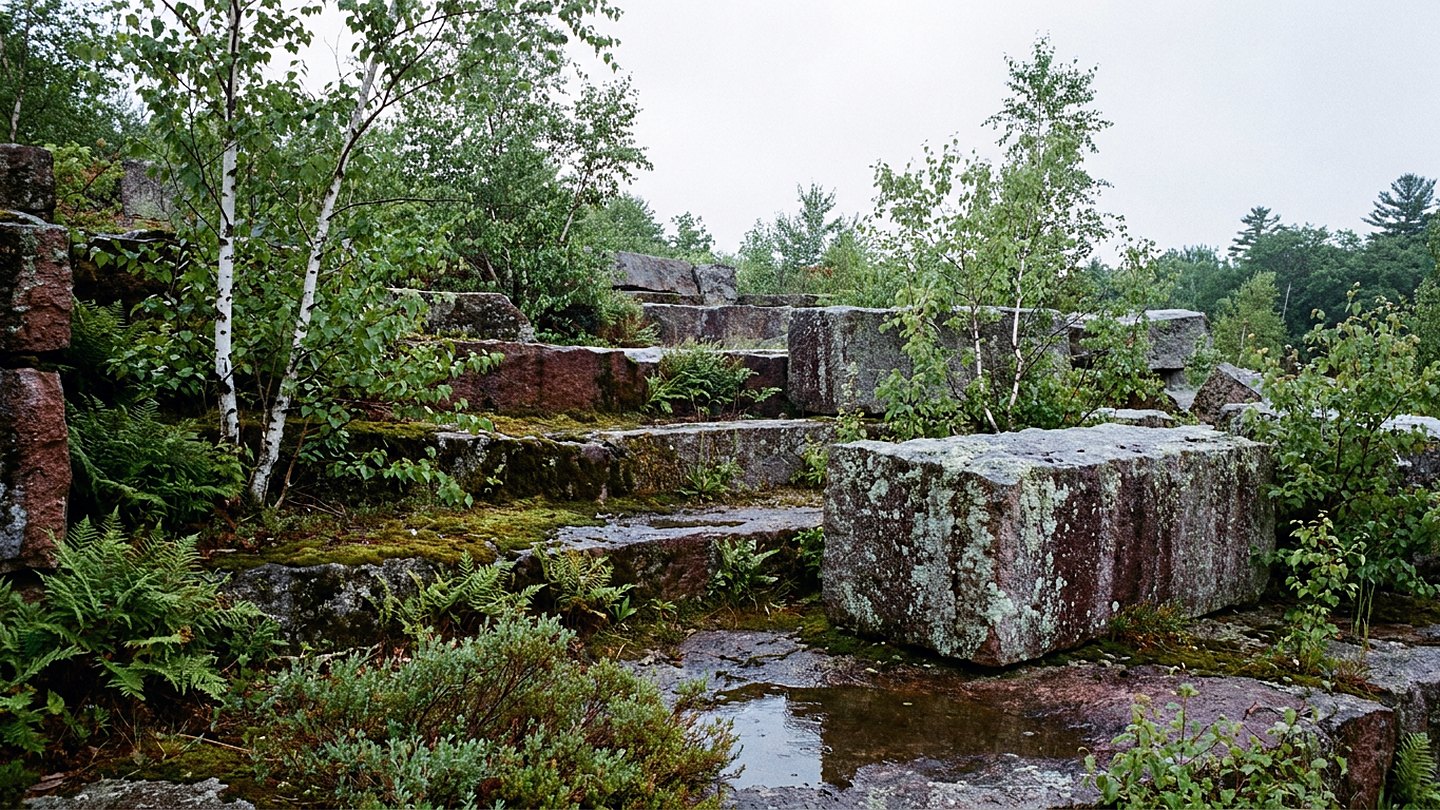
What April gave me instead was the ground. The old cutting yards sit at the edge of the village where the slope starts, and in April they are half water. These are the flat areas where the stone was worked after it came out of the ledge, and the ground there is not soil. It is chip and grit, six inches deep in places, gray, and it drains badly. My boots came back the color of the sidewalk.
Things still standing in the yards, as far as I could tell:
- Four squared blocks, each roughly the size of a chest freezer, with drill marks down one face
- A line of iron pins set into the ledge, rusted to a dull orange, spaced about eight inches
- Two concrete pads with bolt patterns and nothing on them
- One steel cable, thick as my wrist, half buried and going nowhere
The road up to the workings themselves ends at a gate with a sign about private property, which is clear and reasonable and I turned around. The view from the gate is fine. You can see the stepped face of the old cut through the trees, gray and horizontal, with young birch growing out of the ledges. That is the whole picture, and it took me under a minute to see it.
Third visit, June, the museum was open
Third time, a Saturday in June, at ten fifteen. The door was propped with a stone, which I choose to read as local humor.
The museum is two rooms in a former commercial building. There is a woman at a desk who asks where you came from and writes it in a book. There is no admission charge and there is a jar. The collection is exactly what you would guess and better than you would guess: drill steels in a rack by length, a set of wedges and shims, photographs of crews standing on the working face in numbers that seem impossible now, and payroll ledgers open under glass.
The photographs are what stayed with me. In one of them, dated in the 1890s, there are forty-one men on a single stepped face, and I counted them twice because the number seemed wrong. The town has under two thousand people now. Then, the stone employed several hundred of them, and the photographs make that arithmetic physical in a way the text panels do not.
I asked about the yards. She said the flat ground floods every spring and always has, and that the chip layer is deep enough that nothing grows on it properly except birch, which will grow on anything. Then she went back to her book.
Total time inside: fifty minutes. Three hours a Saturday from June through September comes to about fifty-two hours open in a year. I have thought about that ratio more than once.
What three visits taught me that one would not
One visit would have given me a quiet town with old stone in it. Three gave me the sequence, which is different.
The stone left, the work left, and the material stayed exactly where it was because nobody could move it and nobody needed to. The curbs are still granite because replacing granite curbs with anything else would be a project. The steps are worn into dishes because a hundred and thirty years of feet do that. The yards are empty because emptying them was never worth it, and full because emptying them was never worth it.
That is a slow story and it does not fit in an afternoon. It fits in three afternoons, one of which is mostly mud.
Going back
I will go back in September, on a Saturday, before the museum closes for the year, and I will bring a question rather than a general interest, because the woman at the desk clearly knows more than the panels do.
Go if you like looking at how a place is put together and are content with looking. Go on a Saturday between June and September if the museum matters to you, and confirm hours by telephone rather than assuming, which is advice I am giving myself.
Do not go expecting access to the workings. The gate is real, the property is private, and the view from the road is the view you get. The village sidewalks are steep in two places and the granite slabs are uneven from frost, so this is not a smooth-surface walk. The yards are open ground with loose grit, standing water in spring, and no marked path. There is a diner and not much else, so eat before or plan on a short menu, and do not count on a restroom outside of business hours.
What I checked
- Public pages of the town historical society, general notes on the stone industry and museum hours
- State geological survey pages, general background on granite in southern New Hampshire
- Town and county pages for parking, road conditions, and the village walking loop

Asma Tarrant, founder and editor. Filed from Manchester, New Hampshire.