
The Island That Changes Size
A small island in the Merrimack, reached by a footbridge, keeps growing and shrinking between April and August. Six visits, one pad of paper.
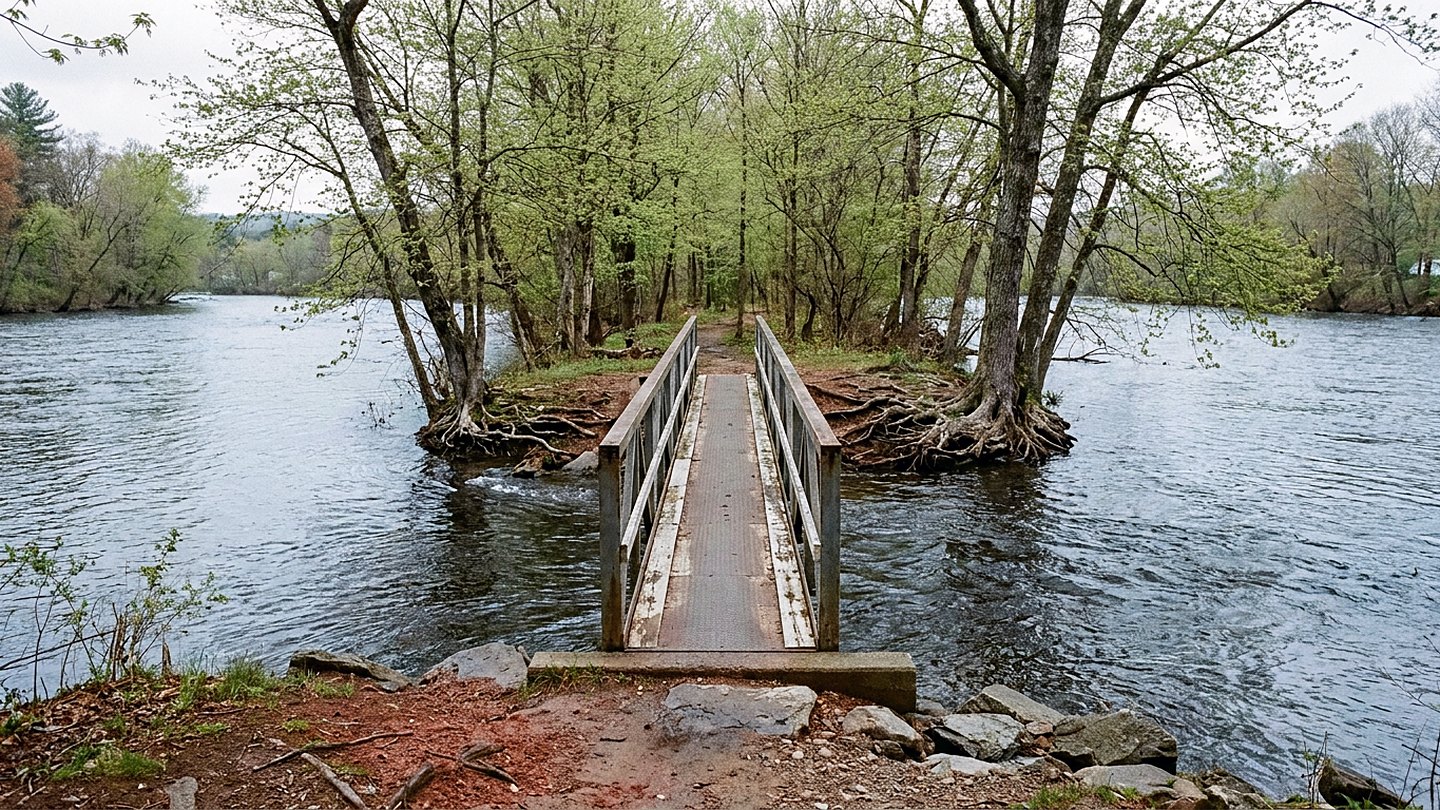
The island sits in the Merrimack about fifteen minutes north of my usual errands, and I have walked out to it six times since the spring of 2024. It is small. On the town map the label runs longer than the land it names, which tells you most of what you need to know. A footbridge reaches it from the east bank, roughly ninety feet of steel grating with a rail on both sides, and that bridge is the only reason anyone bothers.
What keeps me coming back is that the island refuses to hold one size. In April the water pushes hard at both ends and the walkable part is a narrow spine of roots and gravel. By late August a whole bar opens on the downstream end, pale and dry, like a room that had been closed for the season and was quietly reopened.
I am not a hydrologist and I do not carry a measuring stick. I carry a pad, a pen that gives up below freezing, and the habit of standing in the same three spots every time. That turns out to be enough.
April, when the river does the talking
My April visits are loud. Not dramatic, just loud, the way a highway is loud when you stand close to it. The water moves under the grating with a steady pressure sound, and you feel it in the rail before you hear it.
On the visit I remember most, the deck of the bridge sat maybe four feet above the surface. In August that same deck stands somewhere near eleven feet up, and you can see the whole underside of it from the bank. The difference is not subtle. In April the upstream point of the island is simply not there, and the path I usually take is water moving sideways through young trees.
Two things were pinned against the upstream end that morning. One was a section of trunk about as long as a car, stripped smooth and lodged at an angle. The other was a blue plastic barrel that had clearly traveled a long way to get there. Both were gone by June. Neither was gone by choice.
I stayed forty minutes and left with wet boots, which is the usual April outcome. The lot at the trailhead had three cars in it, all with people who never left their seats.
August, when the island doubles
Low water is a different place with the same name. The channel on the west side drops enough that you can hear individual sounds again: a truck on the far road, a screen door, one kid a hundred yards downstream having a strong opinion about something.
The gravel bar at the downstream end is the reward. It runs about seventy paces along the water and maybe twenty across at the widest, and it is made of stones sorted by the river into rough sizes, coarse at the head, finer toward the tail. Walking it feels like reading a page someone else already organized.
Here is what I counted on the bar on my last August visit:
- Nine pieces of driftwood long enough to sit on
- Two shoes, not a pair, not close in size
- One length of white rope, knotted at both ends, no rope in between
- Four crayfish claws, all left ones, which I have decided not to think about
- Zero bottles, which I noted twice because it surprised me
The stripe of silt across the middle of the island is the honest record. It sits about knee height on the young trees and it is the same height on every trunk, all the way across. That line is where the river was in April, and the island simply agrees to it.
Birds, in the order they stopped surprising me
The first visit, I wrote down every bird I saw, which is a beginner move and I stand by it. Now I write down four things and skip the rest.
Red-winged blackbirds hold the upstream willows from April onward and they announce this constantly. A great blue heron works the shallow side in the morning, and it has a routine, which is to stand perfectly still until I get bored and then move eleven feet. Mergansers ride the current down the west channel in small groups and never once looked at the island.
The one I wait for is the kingfisher. It comes through fast, low, with a rattling call that sounds like a toy being shaken, and it does not stop. In six visits I have seen it four times, always within the first ten minutes, always going downstream. I have no theory. I just log it.
What the footbridge decides
The bridge is the whole story of access here, and it is worth being plain about it. It is metal grating, which means you can see the water through your feet, which some people find delightful and others find reason enough to stay in the parking lot. There is a rail on both sides at a normal height, the deck is level, and the approach from the lot is packed gravel with no steps.
In high water the town sometimes closes it, and the closure is posted at the lot rather than online in any way I could rely on. Twice I have driven over to find a barrier and gone home. That is a fair trade for fifteen minutes of driving, but it would be a poor trade for ninety.
The lot holds about eight cars and has no facilities of any kind. The path on the island itself is dirt, uneven, with roots that move between seasons, and it is not something I would take a stroller onto. From the bridge alone, though, you get a genuine view of both channels, and honestly that is sixty percent of the visit.
What I keep getting wrong
Every year I expect the island to come back exactly as it was, and every year it declines. The gravel bar shifts its shape. A tree that stood through three of my visits was flat by the fourth and gone by the fifth. The path bends slightly west now compared to my first notes, and I only know that because I wrote down which side of a boulder I passed on.
That is the argument for going back to one small place instead of visiting many. A single visit gives you a photograph. Six visits give you a slow film, and the film is more interesting even though nothing in it is remarkable.
Going back
I will keep going, probably twice a year, once in the high water weeks and once in the last stretch of August. That pairing is where the whole point lives, and a visit in either half alone would leave you with half the island.
Go in April if you want the sound and the sense that the river is busy with something. Go in late August if you want to walk the bar and sort stones by size like a person with time. Bring boots you do not care about in spring and expect the upstream end to be missing.
Skip it if open grating over moving water is not for you, or if you need paved surfaces, seating, or a restroom, because there is none of that here. Skip it also if you want a destination worth an hour of driving, because it is not. It is worth fifteen minutes, repeatedly, which is a different and in my opinion better arrangement.
What I checked
- Public pages of a regional river association, general notes on seasonal flow and volunteer cleanup days
- Town parks and recreation pages for the footbridge, the lot, and posted hours
- State environmental pages, general guidance on spring high water along the valley

Asma Tarrant, founder and editor. Filed from Manchester, New Hampshire.