
Fifteen Minutes on Old Boards
A one-lane covered bridge, fifty minutes out, visited in the coldest week of the year. The visit itself lasted a quarter of an hour.
The errand was to stand on a covered bridge for a while in the middle of February and then drive home. I did not bring a camera, because the last two times I brought one I spent the visit composing instead of standing. The whole trip took two hours and eight minutes, of which fifteen minutes happened at the bridge.
I have crossed this one perhaps thirty times in a car without stopping, which is how most people meet it. It sits on a back road that connects two small towns, and it carries real traffic, mail, oil trucks in the wrong season, teenagers who slow down out of respect or out of fear of the sign. Driving through takes nine seconds. That is not enough time to notice a building you are inside of.
So in February, on the coldest morning of the month, I went out specifically to be slow about it. This is the entry for that.
The drive out
Fifty minutes northwest, mostly on two-lane roads that were cleared well and salted lightly. The last three miles are the interesting part. The road narrows without announcing it, the shoulders become snowbanks with vertical faces, and the center line stops existing somewhere near a farm with a blue silo.
State pages describe these crossings honestly. Most carry posted weight limits and a posted height limit, and the numbers are lower than drivers expect. The sign at this one gives six tons and eleven feet six inches. I have watched a delivery van approach, read the sign, reverse two hundred feet, and take the long way around, which added maybe twelve minutes to that driver's morning.
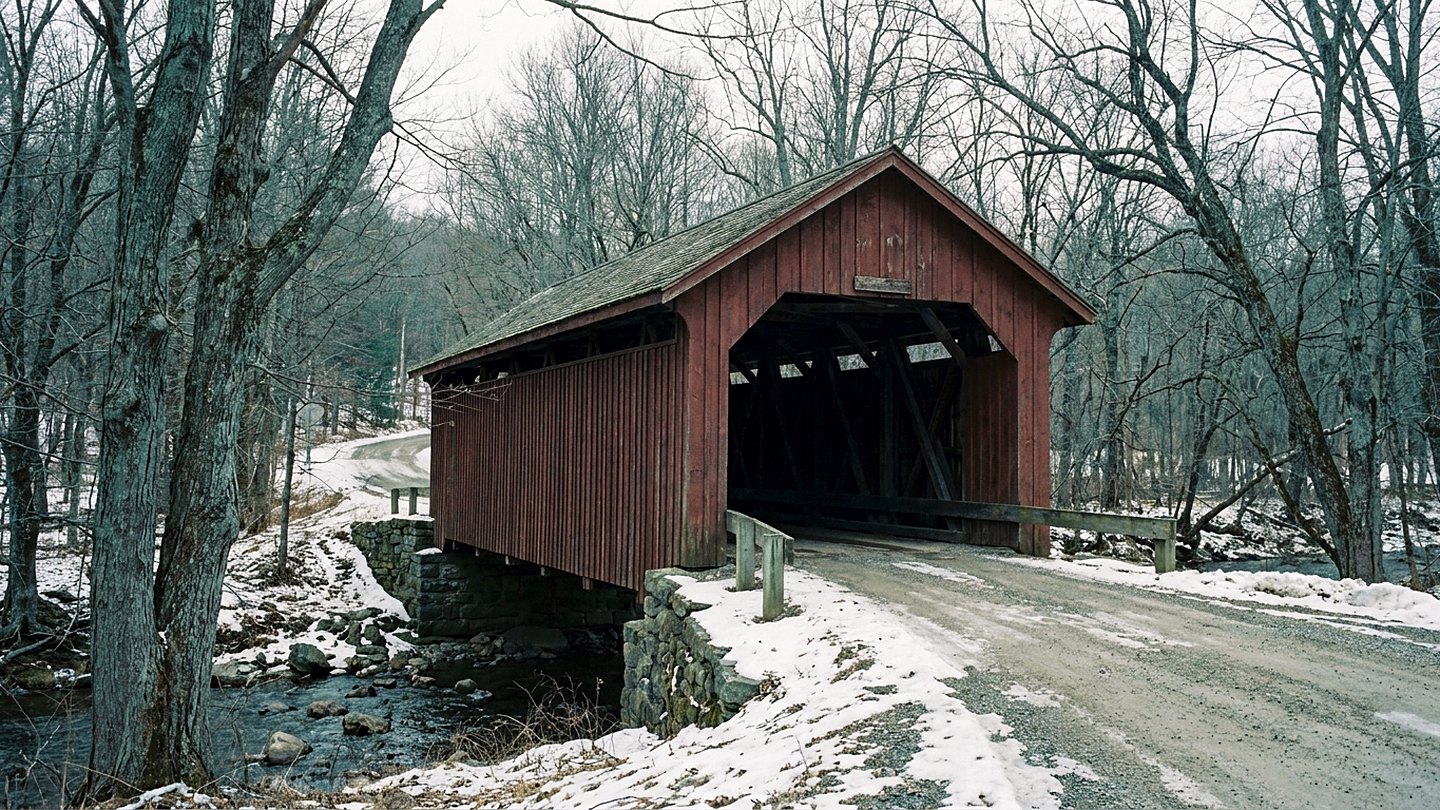
The approach is a curve, then a short straight, then the opening. In summer the opening reads as a dark rectangle. In February, with the snow throwing light up from the road surface, it reads as a lit tunnel with a dark frame, and you can see all the way through to the far field.
I drove past it first, on purpose, to reach the turnaround. Then I came back and looked for somewhere to put the car.
Parking, which is the hard part
There is a pull-off on the near side, on the right, and in July it holds four cars comfortably. In February it holds one and a half. The plows push everything to the outside edge, so the usable surface shrinks to a shelf of packed snow with a lip at the far end that you cannot see until you are on it.
I parked with two wheels on gravel and two on ice, at an angle that would have embarrassed me in a parking lot. There was no other car within a mile. That is the reward for going out at eight in the morning in the coldest week of the year.
Getting out of the car took some care. The pull-off had a glaze under a half inch of dry snow, the kind that looks like a surface and behaves like a slope. I took short steps to the road and then walked in the tire track, which is what everyone does out there, and which works precisely until a truck arrives.
Nothing arrived. In fifteen minutes, two vehicles crossed the bridge, and I heard both of them well before I saw them.
Inside, for fifteen minutes
The deck is transverse boards, worn pale in two lanes where tires ride and darker along the edges where nothing does. Some boards are newer than others by an obvious margin. You can read the repair history of the whole thing just by walking across and looking down, which takes ninety seconds at a normal pace, or about four minutes at mine.
The frame is heavy timber with long diagonals crossing each other along both walls, pinned with wooden pegs at the joints. Everything is dry, gray, and faintly furry with old dust that the wind has never quite reached. There are initials carved into the lower rail near the middle, dated 1974, 1991, and one from 2019 done with less commitment than the others.
Three window openings on each side let in bands of light. In February the sun sits low enough that those bands land on the opposite wall instead of the deck, so you walk through a dim corridor with bright stripes floating at shoulder height. I stood in one for a minute to see whether it was warm. It was not.
Under the far end the river was mostly frozen with a dark channel down the middle, moving fast enough to be audible. There were animal tracks along the near bank, going somewhere with more purpose than I had.
What it sounds like
This is the part I actually came for. A covered bridge is a wooden box with two open ends, and it treats sound like a room, not like a road.
Footsteps land with a hollow knock that arrives twice, once from the deck and once off the roof. A car crossing at fifteen miles an hour makes a rolling drum sound that rises as it enters and falls as it leaves, and the whole structure passes it along like a person clearing a throat. I heard the second car for eleven seconds before it appeared and for nine seconds after it left.
If you speak inside, your voice comes back flatter than you expect. It is not an echo in the canyon sense. It is closer to talking in a stairwell with a low ceiling. I said good morning to nobody, mostly as a test, and the result was unsettling enough that I did not repeat it.
The wind does something else entirely. It moves through the window openings rather than the ends, so it arrives in short pulses instead of a steady stream, and the old timbers answer with occasional single ticks. That morning the sky was clear, the temperature was around eight degrees, and every one of those ticks sounded deliberate.
Worth the errand
Yes, but be clear with yourself about the arithmetic. This is roughly one hundred minutes of driving for fifteen minutes of standing on old boards in the cold. If that sounds absurd, it is, and it was still the calmest quarter hour of my week.
Go early, on a weekday, and go in a car you do not mind putting on packed snow at a bad angle. There is no facility of any kind at the site: no restroom, no shelter, no place to sit, and no cell coverage worth relying on. The nearest town with anything open is nine minutes back the way you came.
It is a poor errand for anyone unsteady on ice. The pull-off is uneven, the drop from the shoulder to the deck level is awkward, and the deck boards are not flat. There is no separated walkway inside, so when a vehicle comes you stand against the frame and wait, which is fine at fifteen miles an hour and less fine when somebody treats the crossing as a straightaway.
Come back in October if you want the version everyone photographs. Come back in February if you want it to yourself. I will take the second one, and I will park badly again.
What I checked
- State pages on historic covered bridges, including posted weight and height limits
- Town public works pages on winter road treatment and shoulder clearing
- Regional public pages listing seasonal road closures near the river crossings

Asma Tarrant, founder and editor. Filed from Manchester, New Hampshire.