
A Trip Made Only for Noon
I drove an hour to stand in a small square and hear twelve strokes from a tower clock. The strike took forty-one seconds, and the square emptied in four minutes.
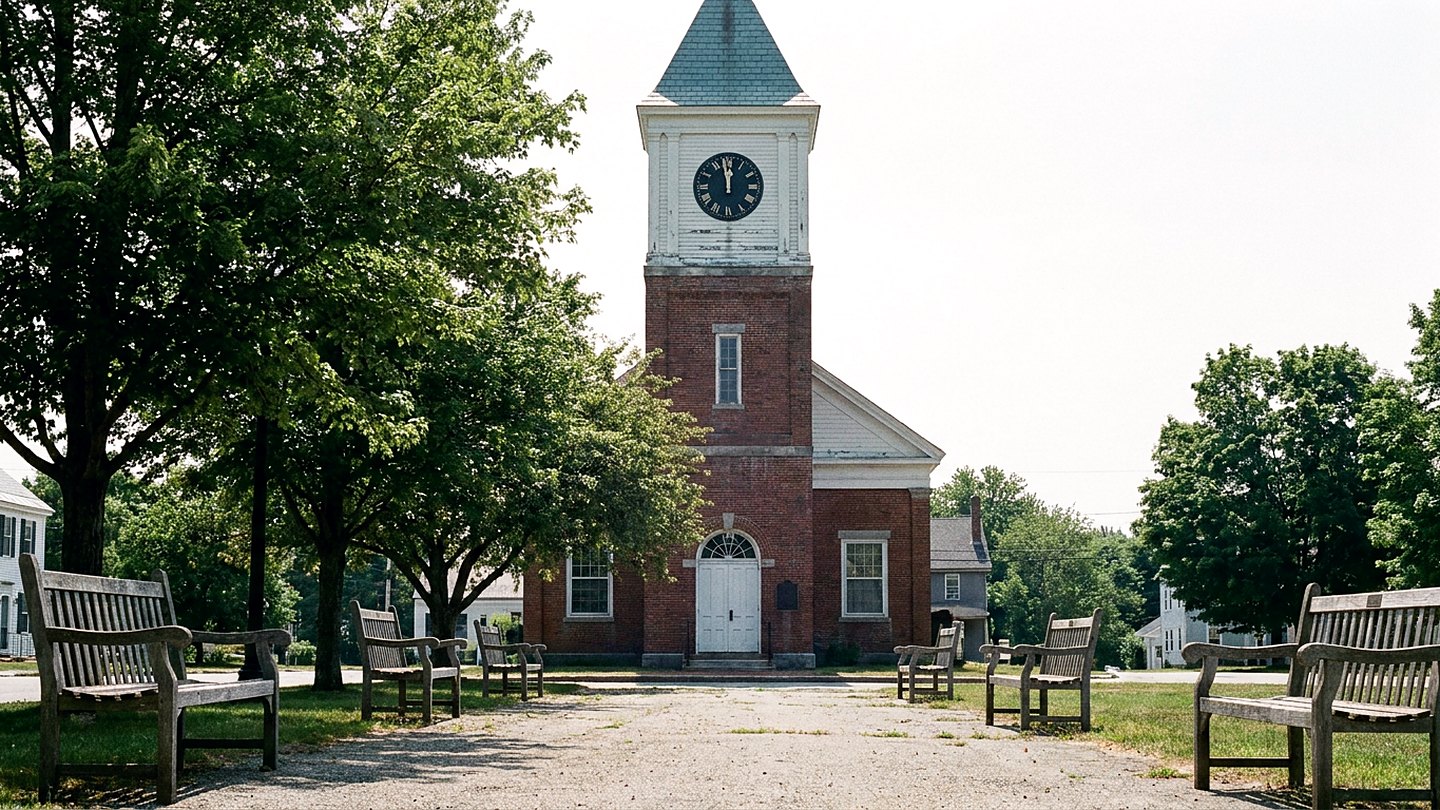
There is a brick tower about an hour southwest of Manchester that strikes the hours over a square barely bigger than a parking lot. I have passed it many times and always at the wrong minute. This June I decided to arrange the whole day around the right one.
The errand was to hear noon. Not to tour the building, not to photograph the face, and not to learn anything about architecture. I wanted forty seconds of sound and the ninety minutes of ordinary square life wrapped around them.
That is a foolish reason to drive sixty miles, and I want to be honest that I knew it while packing the car. It turned out to be one of the better afternoons of my spring.
Arriving at 11:20
I parked in a marked space on the north side at 11:22. The square has fourteen spaces, a two-hour limit, and a granite marker in the middle that nobody reads twice.
The tower rises from the front of the town hall, brick with pale trim, roughly ninety feet to the weather vane. The dial faces the square and measures about six feet across. The hands are black, the numerals are Roman, and the whole face has been repainted recently enough that the white still looks intentional.
I checked the clock against my phone from the far corner. The tower read forty seconds ahead. I noted that and decided to trust the tower for the rest of the visit, since it has held this job much longer than my phone has.
The square before noon
At 11:30 the square held nine people. By 11:52 it held twenty-three, and the increase was almost entirely lunch.
Three of them sat on the low stone wall by the marker. Two more stood near the doors of the town hall with folders, waiting for an office to reopen. A man in work clothes ate standing beside his truck and did not look up at the tower once, which I found admirable and slightly disappointing.
The sounds before noon were completely ordinary. A delivery van idled, a door on a spring closed twice, and someone dragged a folding sign onto the sidewalk. Pigeons held the ledge under the dial in a loose row, facing the same direction, the way they do.
At 11:57 a woman near me looked up, then at her wrist, then up again. She had come for the same thing. Neither of us said so, because that would have been strange.
Forty-one seconds
The strike began at what the tower called twelve. The first stroke was louder than I expected, and it arrived with a flat metallic edge before the round part of the tone opened up underneath it.
The pigeons left on stroke two. All of them, at once, in the direction of the river.
Strokes fell about three and a half seconds apart, and twelve of them took forty-one seconds by my count. That is long enough to become slightly awkward if you are standing in the open with your head tilted back. Around stroke seven I stopped counting and simply listened, then had to reconstruct the last five afterward.
The sound bounced off the brick wall on the south side, so each stroke arrived twice with a very short gap. Under the tower the strike is loud enough that two people covered their ears. From the far corner it is only pleasant.
Then it stopped, and the square sounded emptier than it had at 11:59.
What a visitor can see of the mechanism
The tower is not open on an ordinary Wednesday. The historical society runs an open house one weekend each September, and that is the only public access I could confirm.
From the ground you can still see how it works. A hammer sits outside the bell, visible through the louvers when the light is right, and it draws back and drops rather than swinging the bell itself. The bell is fixed in place. Town records describe a clock installed in the early 1890s and converted from hand winding to a motor in the early 1960s, which is the usual story for a tower this size.
Someone still climbs those stairs several times a year. The minutes I read mention adjustment after power failures, a replaced hammer spring, and a note that the clock loses time in humid weather. That last line explains my forty seconds, or at least gives me a comfortable theory.
A caretaker I spoke with briefly said the strike is silenced overnight and restarted in the morning. She also said nobody on the current staff can climb the last ladder without disliking it.
The square after
By 12:04 the square held nine people again. The lunch group had gone in almost exactly the same order it arrived, which suggests the same buildings and the same schedules.
The woman who had looked up at 11:57 walked off toward the post office without a word to anybody. The man by the truck folded his paper bag into quarters and put it in his pocket. The pigeons came back at 12:06 and reformed the same row on the same ledge.
I stayed until 12:40 to see whether anything else happened. Nothing did, and that was the correct result. A square like this holds one event per hour, and I had come for the loudest one.
On the walk back to the car I noticed a second, smaller clock over a shop door, stopped at 4:20 and clearly stopped for years. Nobody has fixed it and nobody is bothered. The town keeps one clock honest, and that is apparently enough.
Worth the errand
Yes, if you understand what you are buying with the drive. You get one minute of genuine event and an hour of watching a small place work, and the second part is the reason to go.
Arrive at least twenty-five minutes early. The square is small and the good corners fill up with parked cars rather than people. Stand at the south side if you want the doubled sound, and stay well back from the tower if loud noise bothers you or anyone with you.
It will not suit everyone. There is no shade in the middle of the square, the stone wall is the only place to sit, and the sidewalks around the north side are uneven brick that has heaved in places. Public restrooms exist inside the town hall but only during office hours, which end early on Fridays.
The tower itself stays closed except for that September weekend, so do not plan a trip around going up. Plan it around standing still for forty-one seconds. That was enough for me, and I have already picked a Saturday in October to do it again.
What I checked
- Town pages for the municipal building, including square parking rules and posted office hours
- Local historical society pages about the tower clock and the year it was installed
- Public meeting minutes posted by the town that mention maintenance of the striking mechanism

Asma Tarrant, founder and editor. Filed from Manchester, New Hampshire.