
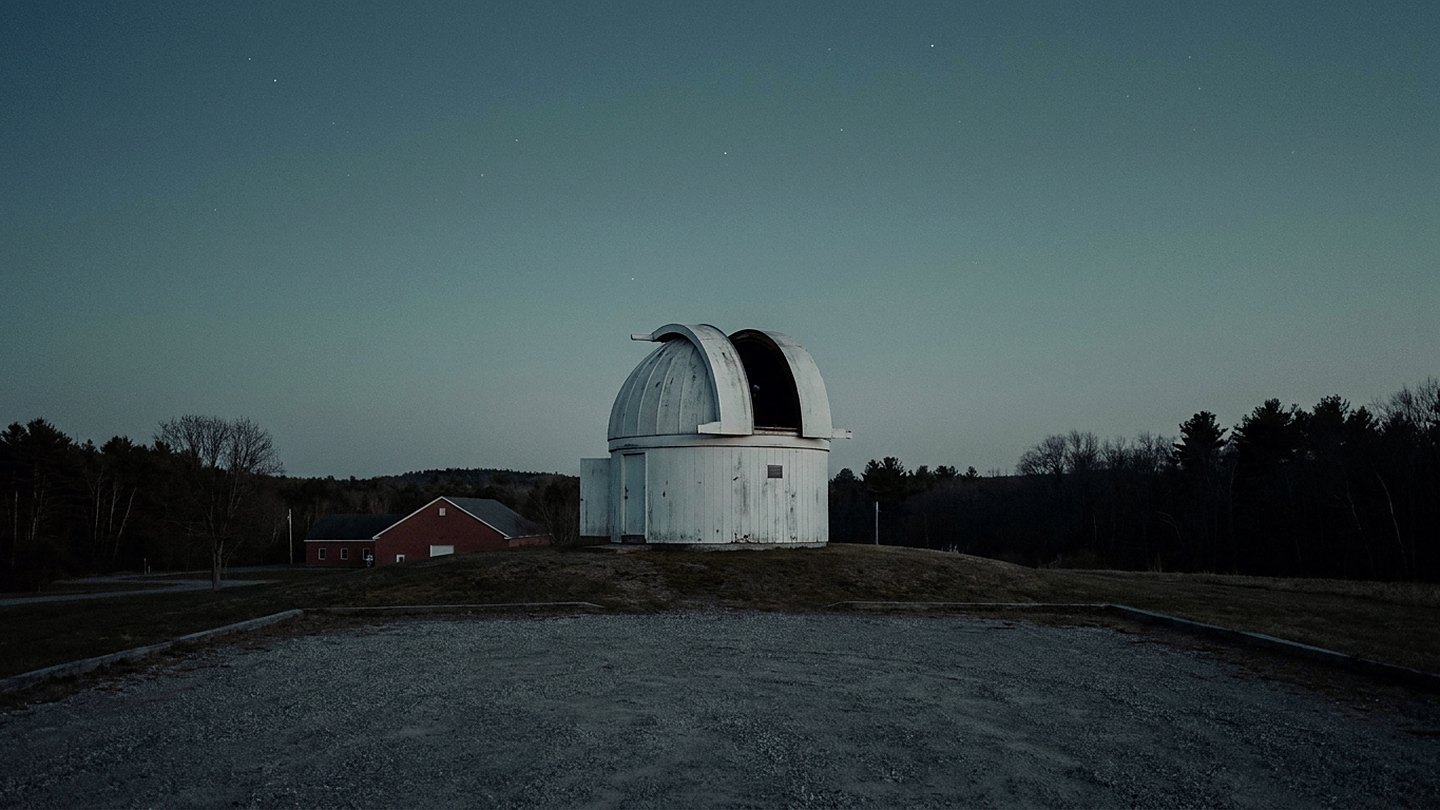
An Evening at a Small Observatory
A public open evening on a hill, one telescope, thirty-one people, and a line that moved every twenty-five seconds. Then a long dark drive home.
The observatory sits on a hill in central New Hampshire and opens to the public on a handful of clear evenings each summer. It is one dome, one telescope, and a rotating group of volunteers who have clearly done this many times. Admission is free and the parking lot is gravel.
I went on the eighth of July, which is late enough in the year that full darkness arrives inconveniently. Sunset was just after 8:20. The doors opened at 8:30, and nothing worth looking at was visible for another forty minutes.
That gap is the honest center of this errand. Most of an evening at a small observatory is waiting, and I want to describe the waiting properly rather than skip to the good part.
Leaving late on purpose
I left Manchester at 7:15 and reached the lot at 8:34. The last two miles climb a town road with a gravel surface and no shoulder, and the sign at the bottom warns that it is not maintained in winter.
The lot holds maybe thirty cars if people park in rows, which on this evening they did not. From the lot a packed dirt path runs uphill about a hundred yards to the dome. It is short, but it is a real slope, and two people ahead of me stopped halfway.
At the top there is a small building with a hand-lettered sign about what to expect. The dome is roughly sixteen feet across and the shutter is opened with a crank by a volunteer who counts turns aloud. The telescope inside is a reflector with a fourteen-inch mirror on a fork mount.
While the sky was still blue we stood around outside and talked about clouds. This is apparently the standard opening conversation and everyone participates.
The rules about light
A volunteer at the door handed out small red flashlights and explained the rules twice, once cheerfully and once firmly.
No white light after dark, anywhere on the hill. Phones stay in pockets or face down, and if you must use one, the screen goes to its dimmest red setting first. No headlights in the lot. When you leave, you roll down to the gate on parking lights and switch to headlights only at the road.
The reason is simple and physical. Eyes take about twenty minutes to adjust to darkness and about one second to lose it. A single phone screen at the wrong moment resets thirty people at once, and everybody in the line knows it.
The rules held all evening, with one exception around ten o'clock when a car door opened in the lot and lit half the hillside. Nobody said anything unkind. The volunteer just called out that we would all get it back in twenty minutes, and we did.
I also noticed how little light the site itself uses. The building has two shielded fixtures pointed straight down, and the path is marked with reflective tape rather than lamps.
The line at the eyepiece
By 9:10 there were thirty-one people on the hill, including six children and a step stool that stayed busy all evening.
The line moves faster than you expect. Each person gets roughly twenty-five seconds at the eyepiece, and a volunteer stands at your elbow telling you where to look inside the field. You do not touch anything. You put your eye close without pressing, keep both eyes open if you can manage it, and then step back down.
Twenty-five seconds sounds unfair until you have waited through eleven of them. The pace is the only reason everyone gets a turn before the humidity wins.
We looked at four objects over about ninety minutes. Between objects the telescope swung and the dome rotated with a sound like furniture moving upstairs, and the line rearranged itself in the dark by voice alone.
Around 10:30 a volunteer appeared with a hair dryer on a long extension cord to clear dew off the eyepiece. This is apparently routine in July. It was the single most useful thing I saw all evening.
What I saw, and what I did not
Vega sat almost overhead and was the first thing bright enough to find without help. It was also the answer to about half the questions asked out loud.
Albireo was the surprise. Through the eyepiece it separates into two stars, one gold and one blue, and the color is obvious rather than something you have to talk yourself into. Three people in front of me said some version of the same short sentence.
The Ring Nebula looked like a faint gray smoke ring and nothing more. No color, no detail. The volunteer said so before anyone could be disappointed, which I thought was good practice.
Mizar split cleanly into two, and Alcor sat off to the side, visible without the telescope once your eyes were ready.
What I did not see matters just as much. No color in the nebula. No galaxies, because the haze near the horizon closed that part of the sky. No meteors, despite four separate people announcing them. The Milky Way was present but faint, a smudge rather than the river it becomes farther north in September.
The drive home
I left the hill at 11:20 and rolled down to the gate on parking lights, which is stranger than it sounds and takes real attention on gravel.
The drive back took fifty-two minutes. The first ten were slow, because the road is unlit and my eyes had spent three hours learning to work in the dark. A deer stood in the ditch about a mile from the turn and did not move as I passed.
By the time I reached the highway the sky was ordinary again, washed out by the towns. That contrast is part of what the evening buys you, and it lasts about as long as the drive.
Worth the errand
Yes, and I plan to go back in late September when darkness arrives at a civilized hour.
Check the sky before you leave, because these evenings are canceled for clouds with very little notice, and the notice appears on the site rather than by telephone. Dress for ten degrees colder than the valley. Bring a red flashlight if you own one, and leave the white one in the glove compartment where it cannot embarrass you.
It will not suit everyone. The path from the lot is uphill on packed dirt with no railing and no lighting. The dome floor has a step up and very little room to turn around. There is one restroom in the lower building and a long walk back to it in the dark.
Children did fine, but the ones under about six were finished by ten. The evening runs late by design, and there is no way to shorten the waiting without missing the point of it. If you can accept two hours of standing around for four short looks, this is a good use of a clear July night.
What I checked
- Public pages of the observatory, including open evening hours and the visitor rules about light
- State pages about outdoor lighting and dark sky areas in northern New England
- Town pages for the hill road, covering seasonal closures and overnight parking limits

Asma Tarrant, founder and editor. Filed from Manchester, New Hampshire.